Can I afford this reorder? How to run the cash and stock numbers together
A five-step affordability check for stock orders: turn the PO into a payment schedule, map it onto your cash calendar, find the low week, and decide. With a full worked example.


The short answer: an order is affordable when your projected cash balance stays above your minimum buffer in every week the order touches, not just on the day you place it. To know that, you turn the order into a payment schedule, lay it onto a weekly cash calendar with everything else that's leaving the account, and look at the lowest week. Here's the five-step version, then a full worked example.
This picks up where how much stock should I order left off. That post sized the order: 1,000 units at £9.20 landed, £9,200 all-in. This one decides whether to place it.
The five-step affordability check
- Turn the PO into a payment schedule. Your supplier terms, not the invoice total, are what hit the bank. 30% deposit on order and 70% on shipping is common: for our £9,200 order that's £2,760 now and £6,440 in about five weeks.
- Build the weekly cash calendar. Eight weeks is enough. Start from today's balance, add your average weekly net from trading (sales in, minus ad spend, ops and subscriptions), then place the lumpy items on their real dates: payroll, VAT or sales tax, loan payments, and every other stock order.
- Drop the PO payments in and find the low week. The question is never "is the total affordable", it's "which week does this order make dangerous".
- Compare the low week to your buffer. Pick a hard floor and treat it as real. A sane floor: one week of operating costs plus one delayed platform payout, because both happen.
- Decide with three honest options. Proceed; shift or shrink the order; or renegotiate the terms. All three are wins compared to finding out in week six.
The worked example
Same brand as the sizing post. Today's balance £22,000, average weekly net from trading +£2,500. Monthly payroll £6,500 (weeks 2 and 6), VAT quarter £11,200 due week 3. The order: £2,760 deposit in week 1, £6,440 balance in week 5.
| Week | Trading net | Lumpy items | Closing balance |
|---|---|---|---|
| Start | £22,000 | ||
| 1 | +£2,500 | Deposit −£2,760 | £21,740 |
| 2 | +£2,500 | Payroll −£6,500 | £17,740 |
| 3 | +£2,500 | VAT −£11,200 | £9,040 |
| 4 | +£2,500 | £11,540 | |
| 5 | +£2,500 | Balance −£6,440 | £7,600 |
| 6 | +£2,500 | Payroll −£6,500 | £3,600 ← low week |
| 7 | +£2,500 | £6,100 | |
| 8 | +£2,500 | £8,600 |
The order "fits": no week goes negative. But look at week six. £3,600 is one delayed Shopify payout or one ad-spend overrun from zero, and it lands the week after the balance payment, which is exactly when you can't cancel anything. By the day-you-place-it test this order looked easy, £22,000 in the bank against a £2,760 deposit. The low-week test tells the truth.
Same order, moved two weeks
Shift the PO so the deposit lands in week 3 and the balance in week 7:
| Week | Lumpy items | Closing balance |
|---|---|---|
| 1 | £24,500 | |
| 2 | Payroll −£6,500 | £20,500 |
| 3 | VAT −£11,200, deposit −£2,760 | £9,040 |
| 4 | £11,540 | |
| 5 | £14,040 | |
| 6 | Payroll −£6,500 | £10,040 |
| 7 | Balance −£6,440 | £6,100 ← low week |
| 8 | £8,600 |
Same order, same totals, and the low week went from £3,600 to £6,100. Nearly double the headroom, bought with a two-week shift. On the stock side, check the delay against your reorder point and safety stock: in this example the brand was 11 days above its reorder point, so a two-week shift eats the margin but keeps the safety buffer intact. That's the whole trade, laid out honestly: a little stock risk for a lot of cash safety, and you get to choose it instead of discovering it.
If the shifted order still breaches your floor: shrink it (order 700 units instead of 1,000 and reorder sooner), or renegotiate terms (a 20% deposit or 60-day balance moves the whole schedule). Suppliers say yes to this more often than founders expect, because a customer who plans payments is a customer who makes them.
Why nobody's tool does this for you
Your inventory planner recommends the order but can't see your bank. Your cashflow app sees the bank but doesn't know the order exists until you type it in as a budget line, and it goes stale the moment the supplier slips a week. So the low-week check lives in a spreadsheet you rebuild every time, or in your head. That gap is the entire reason Cushion exists.
Keep reading
 Guides
How much stock should I order? The formula, with a worked example
Read more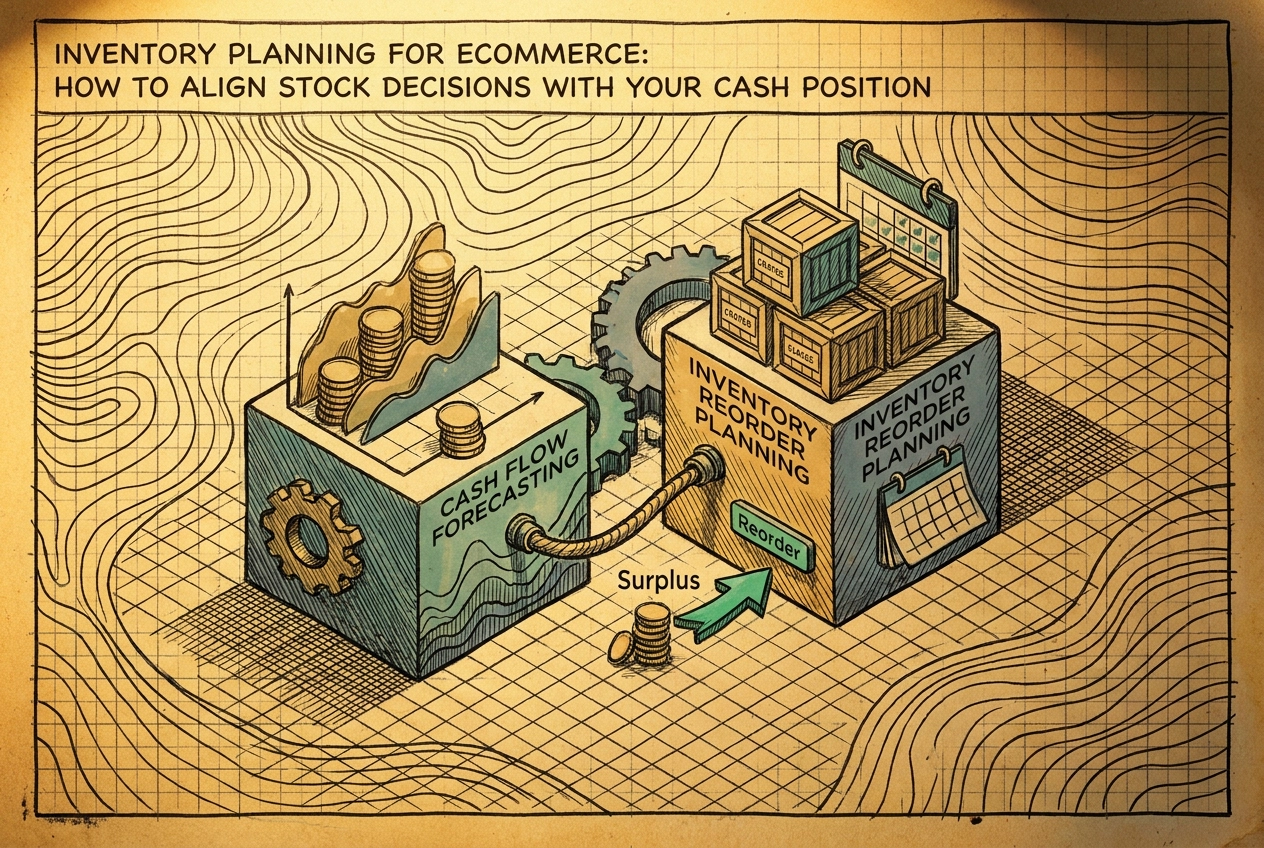 Guides
Inventory Planning for Ecommerce: How to Align Stock Decisions with Your Cash Position
Read more Guides