How much stock should I order? The formula, with a worked example
The reorder point, safety stock and order quantity formulas, worked through with real Shopify numbers, plus the check every inventory planner skips: whether you can actually afford the order.


The short answer: order enough units to reach your target days of cover at your average daily sales rate, minus what you already have on hand and on order. Place that order when stock drops to your reorder point. Then, and this is the step almost everyone skips, check the order against your cash forecast, because an order you can't pay for on time is the wrong order no matter what the demand math says.
Here's each piece, then a full worked example with real numbers.
The three formulas
Reorder point (when to order): (average daily sales × lead time in days) + safety stock
Safety stock (the buffer): (max daily sales × max lead time) − (average daily sales × average lead time)
Order quantity (how much to order): (average daily sales × target days of cover) − stock on hand − stock on order
That's the whole system. When stock on hand plus stock already on order falls to the reorder point, you place an order sized by the third formula. The safety stock exists because your supplier will be late one day and your best sales week will land while they are.
Worked example: a Shopify brand with one hero SKU
Say you run a Shopify store and your hero product does most of your volume:
| Input | Value |
|---|---|
| Average daily sales | 20 units |
| Best recent daily sales | 25 units |
| Average supplier lead time | 45 days |
| Worst recent lead time | 55 days |
| Target days of cover | 60 days |
| Stock on hand today | 1,600 units |
| Stock already on order | 0 units |
| Unit cost (landed) | £9.20 |
Step 1: safety stock
(25 × 55) − (20 × 45) = 1,375 − 900 = 475 units.
That's your buffer against the bad week and the slow boat happening at the same time. If that number looks big, that's lead time doing it, not the formula. Long lead times are expensive in stock even before they're expensive in anything else.
Step 2: reorder point
(20 × 45) + 475 = 1,375 units.
You have 1,600 on hand, so you're above the line today. At 20 units a day you'll cross 1,375 in about 11 days. That's when the order needs to be placed, not when you notice the shelf looking thin a month later.
Step 3: order quantity
(20 × 60) + 475 − 1,375 = 1,200 + 475 − 1,375 = 300 units to top up… which is wrong.
Wrong because a 300-unit order rarely clears a supplier's minimum, and because you'd be reordering again within a fortnight. In practice you size the order to arrive as stock approaches safety level: by the time a 45-day order lands you'll have sold roughly 900 more units, leaving about 700 on hand. To sit at 60 days of cover plus safety stock (1,675 units) on arrival day, the order is 1,675 − 700 = 975 units, call it 1,000.
The rule that falls out of this: size the order for the day it arrives, not the day you place it. Every unit you'll sell during the lead time has to be added on top, and that's the step people doing this in their head get wrong most often.
The check every planner skips: can you afford it?
1,000 units at £9.20 landed is £9,200, and your supplier wants 30% on order and 70% on shipping. So the demand math just wrote you a payment schedule: roughly £2,760 now and £6,440 in about five weeks.
Now put that against everything else leaving the account in the same window: payroll, the VAT or sales tax quarter, your ad spend, the other SKUs that also hit their reorder points. This is the join that neither a spreadsheet nor a standalone inventory planner makes for you. The inventory tool says "order 1,000 units" with a straight face. It has no idea the VAT bill lands the same week.
Three honest outcomes of that check:
- The cash is there. Place the order. Done.
- The cash is there if you shift something. Push the order ten days, negotiate the deposit down, or delay a discretionary spend. A slightly late order you can pay for calmly beats an on-time order that puts you in your overdraft.
- The cash isn't there. Better to know now, while the answer can be a smaller order or a chat with your supplier, than at the exact moment the 70% balance is due.
Bonus formula: days inventory outstanding (DIO)
One more number worth knowing, because it tells you how much cash is sleeping on your shelves:
Days inventory outstanding: (average inventory value ÷ cost of goods sold) × 365
If your average inventory is worth £48,000 and your last 12 months of COGS is £150,000, DIO = (48,000 ÷ 150,000) × 365 ≈ 117 days. Nearly four months of cash parked in stock. For most DTC brands, 60 to 100 days is a healthy range; well past 100 and the honest question is which SKUs are hoarding the cash and whether the next reorder for them should shrink.
Doing this without doing it by hand
You can run all of the above in a spreadsheet, and I did for years. The problem isn't the formulas, it's that the three inputs live in three places: sales rate in Shopify, stock and lead times in your planning sheet, cash in your bank and your accounting software. The join between them happens in your head, usually at 11pm, usually the week you're least able to think straight.
Keep reading
 Guides
Can I afford this reorder? How to run the cash and stock numbers together
Read more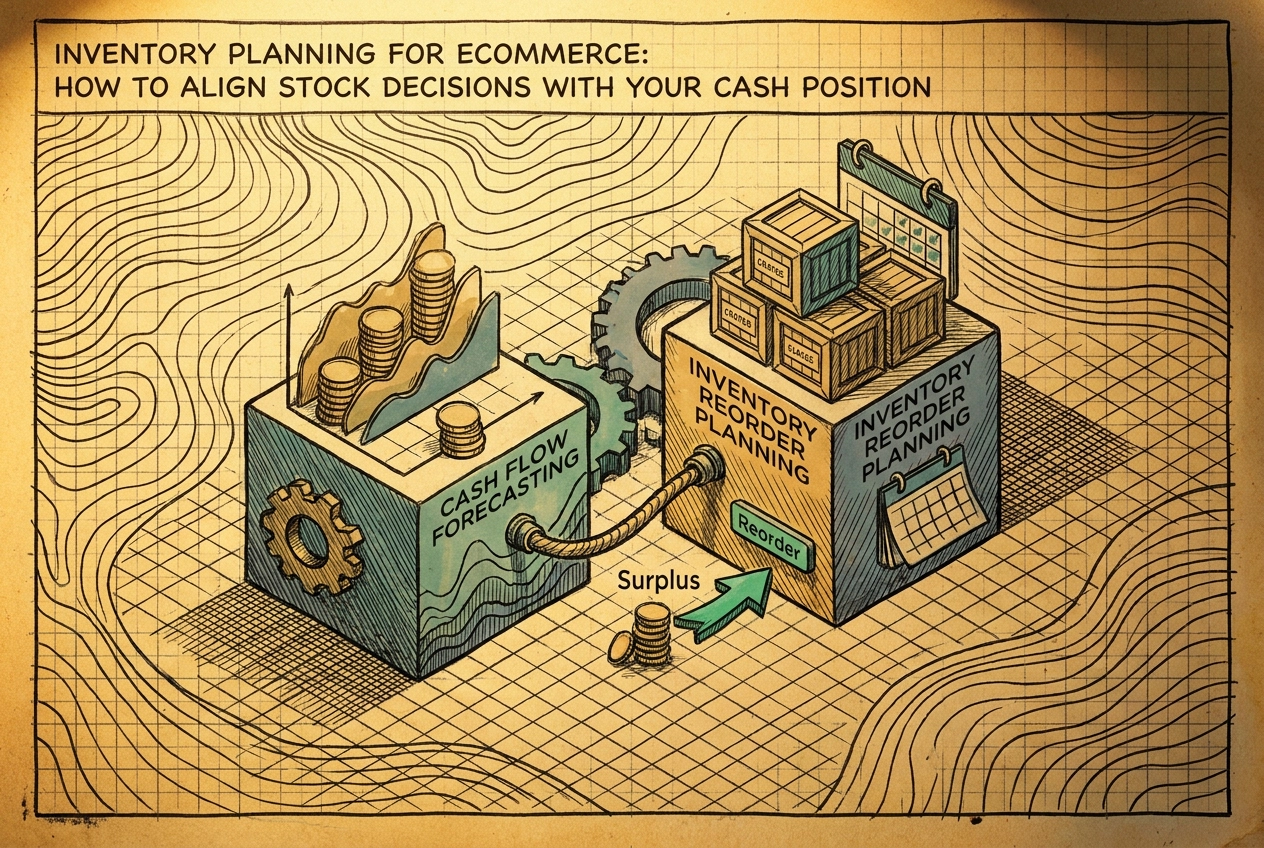 Guides
Inventory Planning for Ecommerce: How to Align Stock Decisions with Your Cash Position
Read more Guides